

A Brief about Ranking a Webpage on Google
The same dream is shared by all the owners of the websites, whereby when you open Google and type your business or keyword, you see your business on the first page. The reason is simple. As soon as a site gets to the first page then traffic grows automatically. And as the traffic grows, the leads, calls and sales will begin to arrive without the paid advertisements.
The fact is that big companies are not the only ones who would get the first page in Google. The small websites, new blogs, and even novice businesses can be ranked as long as they do the right process of SEO. Google does not feature the richest site. Google is ranked the most useful site.
Simple terms put SEO (Search Engine Optimization) as making Google realize your site so that it can display it to the appropriate individuals at the appropriate moment.
The primary task of Google is to resolve the problem of the user. In the event that your website is more effective at resolving the problem than others, Google will rank it higher.
However, in order to get there, you must know how ranking actually works.
The Google Process On Which Website to Rank First
In any time someone types anything in Google, thousands of the websites are fighting over that single place. Google is fast at scanning and comparing pages on the basis of three main questions:
- Relevancy to the search of this page?
- Is this page trustworthy?
- Will the users be pleased when they visit it?
When your site meets all the three, your ranking is better.
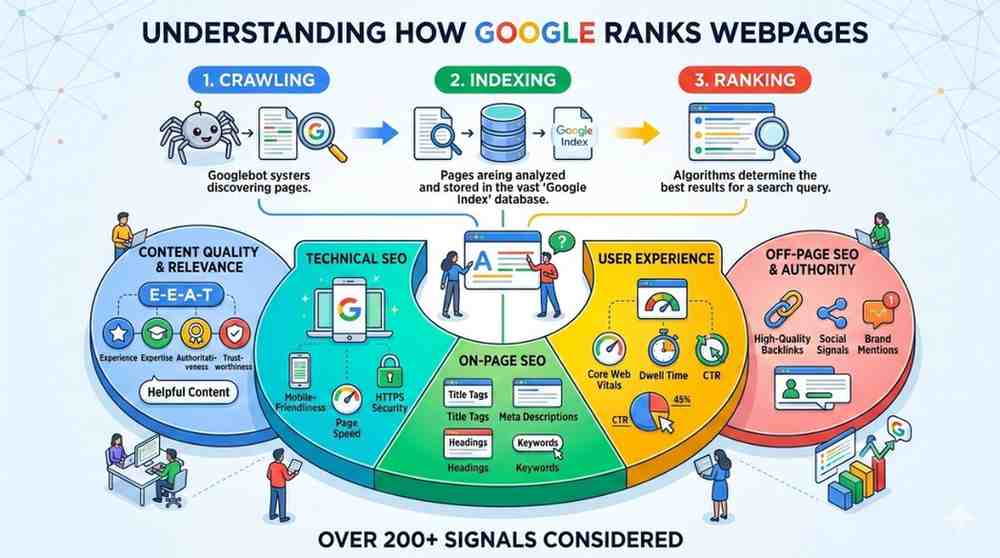
Google incorporates hundreds of factors in-house, yet in practice, they all boil down to five key areas, which are keyword targeting, content quality, website performance, backlinks, and user experience. When these five areas are improved in the right way, then ranking becomes not random rather predictable.
Step 1 — Keyword Research (The Real Starting Place of Ranking)
The failure of most websites is due to their initiation of writing without doing research on what people are searching. SEO does not begin with writing. SEO begins with search intent knowledge.
An example is that of a large number of individuals writing an article with the title of SEO Tips.
This is a very competitive key word and new sites can hardly be ranked with this key word. Instead, if you target a specific search like how to rank website on Google first page, the competition reduces and Google understands your topic clearly.
It is referred to as long-tail keyword targeting.
The long-tail keywords are effective in the sense that they are the exact match with what the user desires. Google begins to put its faith in your site gradually when it realizes that people are getting their answers on your site.
The keywords can be located with the help of Google Autocomplete, People also ask, Google Trends, or with the help of such tools as Ubersuggest, Ahrefs, and Semrush. The easiest way is to enter your subject on Google and see what offers it makes, they are actual searches that take place every day.
Always choose keywords that:
- Have clear intent
- Are specific
- Can be completely discussed in a single article.
After picking a keyword, all the pages you put on your site must be based on answering that one subject in detail.
Step 2 — How to write content that Google really wants.
Previously SEO used to imply adding the keywords repeatedly. Today that no longer works. The Helpful Content system of Google can now read like a human being. It verifies that the article is truly teaching or it is merely a repetition of words.
So ranking content is not long content. It is useful content.
One thing to ask before writing is:
Will a user reading this page have to open up another site?
In case the response is not yes, Google adores your page.
Good SEO writing presents the content in step-by-step mode, clear of doubts, and confusion. The introduction must give the reader an idea of what he or she is going to learn. They are supposed to be governed by the body. The conclusion must be the end and assist them in passing the next step.
Readability is another important factor. There are numerous sites that adopt the use of complex English so as to appear professional yet users can do away with the use of the simple language. The longer the users are in your page, that is a positive signal to Google. It is referred to as dwell time and it has a great influence on ranking.
The keyword should be forced into the title, headings, and body a few times, but never artificial. Google also recognizes it in case it is unnatural to a human being.
Also keep updating articles. Google likes new information. Even minor changes such as the addition of new paragraphs, better explanations, or changing the year references contribute to the preservation of rankings.
Step 3 – On-Page SEO (Helping Google to Know Your Page)
Even a great article would not rank in case Google would not comprehend it adequately. It is there that on-page SEO is relevant.
The first thing read by Google is your page title. It has to be clear about the subject matter and have the key word. A clear title will give Google the exact idea of what is available on the page and it enhances the click-through rate.
The address must be concise and precise. Numerical and random characters in long URLs are not user and search engine friendly.
The headings within the article are important as well. They organize your content in logical parts and assist Google to scan the structure. When Google knows the structure, then it is assured to display your page.
Meta description has no direct influence on the ranking but it has a powerful influence on the clicks. An excellent description is like a preview. Google takes your results as more relevant when people are clicking on your result more than other results and thus enhances your position.
Images also play a role. Adding images will always come with alt text describing the images. This assists Google to grasp visual data and has the potential to cause traffic through Google Images.
Another method that is under-rated is internal linking. Wherever you write another piece of writing, tie it up with the ones you have been writing before. This dispersion of authority in your site and enables search engines to go deeper. To know more about on-page, you can read our On Page SEO Checklist.
Step 4 – Technical SEO (The Secretive Ranking Factor).
Most sites have good content written on them but they still fail to rank due to technical problems. Google favors those websites that are quick and efficient.
Page speed is the most crucial technical aspect. In case your site loads too slowly, over 3 seconds, you lose most of your traffic and they do not even read. Google takes notice of this and minimizes ranking.
You should:
- optimize images,
- use lightweight themes,
- avoid too many plugins,
- and enable caching.
Friendliness on mobile is now a requirement. Over 70 percent searches occur on mobile. Google will not favor your site in case it appears to be broken when it is seen on a cell phone.
Free HTTPS security should also be available on your site. Browsers give warnings and the level of trust goes down without the use of the SSL certificate.
Indexing is another technical factor. There are occasions where pages are not showing up in Google just because they are not being indexed. Google Search Console The faster Google can find your pages, the better it is to submit your sitemap.
Technical SEO does not automatically raise a site to the top but in the absence, ranking a site is difficult to say the least. If you need to understand more in detail about Technical SEO, then you can refer to our Technical SEO checklist.
Step 5 — Backlinks (Establishing Trust and Authority)
The links that point back are also considered to be one of the strongest ranking factors. Backlink implies that some other site is mentioning your page. In the case of Google, this acts as a recommendation.
However, not every backlink is the same. Ten bad links are more destructive than constructive. A single legitimate connection on a meaningful web site, is much more effective.
The best method of creating backlinks is by coming up with useful information people will tend to refer to. Guest posts, contributions in communities, and inclusion of your business on reputable directories are also opportunities that you can write.
Relevancy and credibility are primarily checked at Google. When a site on your niche links to you, then your authority is improved.
Bulk purchasing of random backlinks is not something to purchase. The algorithm used by Google has the ability to identify unnatural link patterns and can de-rank them.
Step 6 — User Experience (The Factor that the majority overlook)
Google is currently monitoring the actions of the users on your site. When visitors visit your page and leave immediately, Google believes that the page did not help them.
Ranking is not just about the coming of visitors, it is also about the fulfillment of the visitors.
Large fonts, correct spacing, easy navigation and organized information hold the users in the game. Even the addition of a table of contents, frequently asked questions and examples can make the interaction significantly better.
The longer the users take time to read, scroll, and visit other pages, the better Google sends a positive signal, thus pushing your page slowly upwards.
How Long Does It Take to Rank?
This is the most ask question.
It normally requires 3-6 months before new websites noticeable ranking movement. The competitive keywords can be time-consuming. However, with the right SEO, things will move in the right direction.
Ranking is not a one-time task. SEO works like farming. Today you plant seeds, and every day you water them, and the results will be seen in the future. Ranked benefits are strong when the benefits are ranked and you get a steady traffic without the cost of advertisements.
Expansions in Common Mistakes that put a halt on Ranking.
Simple mistakes can cause serious harm to the SEO of many websites without any idea of it. Copypasting, stuffing with keywords, slowness of the site, and disregard of mobile optimization are extremely widespread problems.
Impatience is another great error. The strategy people use shifts every week, the articles are deleted, the site is redesigned over and over. Google prefers consistency. Trust comes in when your site is displayed to be stable and to improve upon itself.
Final Thoughts on Ranking a Webpage
It is not a trick, trick or hack of ranking a website on the first page of Google. It is a culmination of proper targeting of the topic, useful content, technically good web structure, and earned trust.
Google eventually rewards your site as long as you are not chasing the algorithm, but instead work on resolving real problems. Each year, search engines are getting smarter, and their task is not difficult, just display the best answer.
Therefore, the true secret in SEO is also not complex:
become the best answer.
Professional advice can also help simplify the process of business or people who do not know where to start. It is time-consuming, experimental and it requires technical knowledge in order to learn SEO and apply it properly. As a result, a number of web owners would want to seek the services of seasoned SEO experts. Sites such as Pro SEO Freelancer are usually visited by individuals seeking to know or apply the right optimization strategy in an organized manner as opposed to taking shortcuts.