
In the current competitive online environment, it is not just enough to have a website. Your website should be optimized to reach the right audience and get ranked in the search engines such as Google in order to be ranked high. It is at this point that On-Page SEO comes in handy. On-page SEO is particularly effective to Indian websites where the intent to use the website and the ability to be visible in search engines need to be put in balance to be sure that the right people are discovering what you offer, whether it involves a product or a service, or information.
As one of the largest and fastest-growing internet markets in the world, the search behavior of users and the benefits of optimization of your company are one of the most valuable factors in traffic, engagement, and conversion.
What is On-Page SEO?
On-Page SEO is the act of optimizing single web pages to be ranked higher in search engines and gain more traffic that are more relevant. It has content and technical aspects that enable search engines to know your page and users to realize value in a page, which clearly explains Why SEO is Important for any website’s visibility and growth.
The main areas of the On-Page SEO are:
- Optimizing page title and meta description.
- Having a correct heading structure (H1, H2, H3).
- Optimization of keywords without overtraining.
- Quality, relevant and user friendly content.
- Internal linking
- Image optimization (alt text, size, format)
- URL structure
- Mobile-friendliness and speed of page.
Simply put, on-page SEO makes sure that the content you have is understandable, helpful, and simple to comprehend not only by users but also by the search engine.
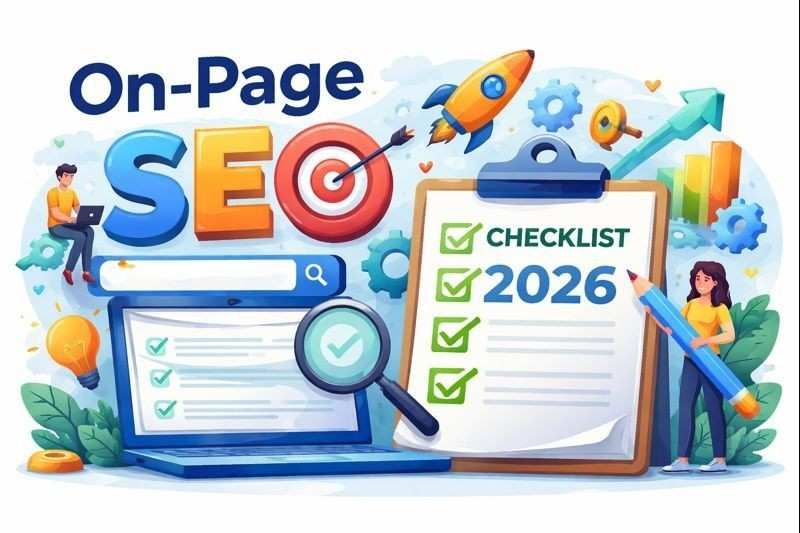
On-Page SEO Checklist (2026 Updated): The Ultimate Guide to Higher Ranking and Higher CTR.
Even in 2026, on-page SEO will still become the basis of search engine ranking. Although AI-powered search, the Helpful Content System created by Google, and algorithms based on user intent have been changed, on-page optimization remains the most manageable SEO variable.
When your pages are not optimized well, then even with the backlinks or the social traffic; your pages will not be saved.
It is a guide to all that you need to know about on-page SEO in the present day and these include:
- Title Tags and meta descriptions.
- Strategies in place of key words which rank.
- Best practices of URL structure.
- Image optimization
- Internal linking
- Heading hierarchy
- Top ten blunders that ruin rankings.
Let’s dive in.
1. On-Page SEO Checklist (2026 Updated)
You can have a 2026 optimized on-page search checklist in a high level before doing the optimization of the individual elements:
One primary keyword per page
Matching clear search intent (informational / transactional / navigational)
Title tag (CTR-oriented) is optimized.
Convincing meta description.
SEO-friendly URL
Proper H1–H6 heading structure
Optimized images (alternative text + size + format)
Internal-linking to the related pages.
No stuffing of natural key words.
Useful, original, experience-based information.
Mobile friendly and fast loading.
And now we will divide each part into detail.
2. Optimizing Title Tags and Meta Descriptions to Get a Better CTR.
The Importance of Title Tags and Meta Descriptions.
Your title and meta description are not merely ranking factors, but they are conversion triggers.
A poor title even at the top of the ranking would mean low click-through rates (CTR), which would in effect performance indirectly.
Title Tag Optimization (2026 Best Practices)
Ideal length:
50–60 characters (desktop safe)
Best Practices:
- Put major keyword at the start.
- Add power words (Best, Ultimate, Proven, Updated, Checklist)
- Insert year or fresh signal where applicable.
- Avoid keyword stuffing
Example:
- On-Page SEO Guide SEO Checklist SEO Tips.
- On-Page SEO Checklist (2026): Increase Rankings and CTR.
Optimization of Meta Description.
Ideal length:
150–160 characters
Best Practices:
- Write like an ad copy
- Address user pain poin
- Include keyword naturally
- Insert CTA (Learn, Discover, Check, Download)
Example:
Know the full on-page checklist of 2026 SEO. Maximize titles, content, pictures and in-text links to be ranked better in Google.
Caution: Google might rephrase meta descriptions, yet high-quality meta description does increase CTR by a great margin.
3. Keyphrase Positioning Strategy That Works.
The placement of key words in 2026 is context-relevant, accurate, and purposeful, and not repetitious.
In Which Position to Put your primary keyword.
Title tag
URL
H1 heading
First 100 words
At least one subheading (H2/H3)
Image alt text
Naturally natural during content.
Semantic Keywords & NLP Terms
Google now comprehends objects and context and not keywords.
Instead of repeating:
on-page SEO
Use related terms like:
- on-site optimization
- search engine optimization
- page-level SEO
- ranking factors
- search intent
This is effective because it allows your content to rank not on one keyword only.
4. Best practices: SEO-Friendly URL Structure.
The URLs are disregarded, yet they are very important in terms of usability and ranking.
Ideal URL Structure
Short
Descriptive
Lowercase
Hyphen-separated
Keyword-focused
Example:
Don’t use: example.com/page?id=123
Don’t use: example.com/on-page-seo-checklist-2026-complete-guide-best-tips
Instead, use this: example.com/on-page-seo-checklist
URL Best Practices (2026)
Do not put dates where it is not time-specific.
- Remove stop words (and, the, of)
- Do not change URLs without 301 redirection.
- Use same URLs throughout the structure.
5. SEO Image Optimization (Alt Text, Size and Format)
Images enhance user experience, yet poor-quality images compromise speed and performance causing poor rankings.
Alt Text Image Best Practices.
Alt text helps:
- Google understand images
- Improve accessibility
- Rank in Google Images
Example:
Don’t do this: alt=”image1″
Or this: alt=”seo”
Instead, do this: alt=on-page-SEO-checklist-to-rank-higher-in-Google.
Image Size & Compression
Large images = slow pages = poor SEO.
Best practices:
- Compress images before uploading
- Keep file size under 100 KB when possible
- Use responsive images
Best Image Formats for SEO (2026)
| Format | Use Case |
| WebP | Best overall (Google recommended) |
| JPEG | Photos |
| PNG | Graphics with transparency |
| SVG | Icons & logos |
WebP images can reduce size by 30–50% without quality loss.
Caution: Do NOT cram keywords – use words to describe the image.
6. Better Rankings by Internal Linking Strategy.
One of these underestimated on-page SEO techniques is internal linking.
Why Internal Links Matter
- Distribute link equity
- Help Google crawl pages
- Improve topical authority
- Increase time on site
- Best Practices of Internal Linking.
Connection between high-authority pages and significant pages.
Use descriptive anchor text
some generic anchor, such as click here, should be avoided.
Have a logical site organization.
Example:
Instead of:
Click here to read more
Use:
Get to know more about on-page optimization of the SEO.
Ideal Internal Link Count
- Short articles: 35 internal links.
- Long information: 8-15 internal links.
Concentrate on the relevance but not numbers.
7. Optimization of Content vs Keyword packing.
What is Keyword Stuffing?
The process of unnaturally repeating keywords to achieve rank is known as keyword stuffing.
Example:
Importance of on-page SEO is that on-page SEO aids the SEO to increase the ranks of the SEO in search engine results…
This kills rankings in 2026.
What Google Actually Wants
Google compensates material that is:
- Helpful
- Experience-based
- Clear
- Intent-matched
- Naturally written
An Ideal Guide to How to Optimize Content.
Write for humans first
Use keywords naturally
Cover topic in depth
Add examples, lists & explanations
Use semantic variations
In case it is awkward to read aloud, it is over-optimized.
8. How Headings (H1–H6) Impact SEO
Headings provide content organization and assist users and search engine.
Proper Heading Structure
- H1: Main topic (only one per page)
- H2: Major sections
- H3–H6: Sub-sections
Example:
- H1: On-Page SEO Checklist
- H2: Title Tag Optimization
- H3: Best Practices
- H3: Examples
Heading SEO Best Practices
Include keywords naturally
Do not omit levels of headings.
Keep headings descriptive
Do not use headings as a style only.
Headings enhance opportunities of featured snippets and readability.
9. SEO On-Page Sins That Kill Ranks.
The following are the mistakes that plagiarize SEO performance:
Duplicate Content
- Existing content on several URLs.
- Missing canonical tags
Over-Optimization
- Keyword stuffing
- Precise-match anchors all over.
Weak Search Intent Match
Ranking of informational content on transactional keywords.
Thin Content
- Low word count
- No depth or value
Poor Mobile Experience
- Slow loading
- Bad layout
Ignoring Internal Linking
Orphan pages with no links
The importance of On-Page SEO to your Websites.
Websites are particularly sensitive to on-page SEO because the competition in almost all niches education, finance, travel, e-commerce, blogs as well as local services, is very high. There are thousands of websites that are optimized on similar keywords and good on-page can make your site stand out.
Some of the main reasons as to why on-page SEO is important in India:
Competition could be very high: Competitiveness of optimised pages is better compared to large brands.
Inexpensive: Lessens reliance on advertisements.
Credibility and trust: The higher the ranking, the higher the trust by the user.
Enhanced user experience: Well organised and useful contents ensure the users are hooked.
Favorable to local search: This is necessary in companies that engage particular cities or regions.
On-page SEO can be the keystone of the long-term organic optimization of Indian startups, bloggers, service providers, and small enterprises.
Search Behaviour of the Indian users.
It is important to know how Indian users search online so as to make maximum out of the on-page SEO. The digital audience in India has some peculiarities that have direct effects on optimization strategies.
1. Mobile-First Users
India is a mobile first nation with most of the searches occurring within smart phones. This means:
- The websites should be mobile friendly.
- Quick speed of loading is essential.
- Small screens should not have complicated content.
Google also employs mobile-first indexing, which also renders mobile optimization a must.
2. Local Search Intent
Local intent search is often done by Indian users, e.g.:
- “near me” searches
- City/region queries (e.g., best CA in Delhi, home loan in Pune, etc.)
The location-based keywords, local cases and explicit business details are useful in optimizing the content to capture this traffic.
3. Mixed-Language and Multilingual Searches.
Many Indian users use search:
- Local languages (Hindi, Tamil, Telugu, Bengali, etc.).
- Mixed language queries (Hinglish such as business loan ka interest rate).
Limiting language, use of conversation keywords and in some cases bilingual phrasing can also drastically enhance relevance and interest.
Final Thoughts: On-Page SEO in 2026
In 2026 on-page SEO will not be about tricks or shortcuts. The search engines are now intelligent and they consider real value, clarity and user satisfaction as far as it is concerned rather than the old methods of optimization.
It’s about:
- Intentional content that really responds to the query of the user.
- Well defined content structure that enhances readability and crawling.
- Good internal connectivity that creates topical authority.
- Mobile and desktop excellence.
- Relevant semantics contributing to relevance of search engines, not mere keywords.
When you regularly check and optimize your pages with this list, you are not only enhancing the ranking, you are creating long-lasting, algorithm-resistant SEO resources. The pages that have been optimized with the appropriate intent, structure, and relevance are likely to do well with the core updates, have a better engagement, and experience long term organic traffic.
In a word, on-page SEO in 2026 will be successful as it will involve matching search engines and human needs. Rankings are not a hardship when your material is useful, well-organized and easy to follow.